Agentic AI
& Automation
Autonomous AI agents that observe, reason, and act, transforming your business processes from manual to intelligent.
Software that thinks, not just executes.
Traditional automation follows rigid rules. Agentic AI goes further: it observes your data, reasons about what to do, plans a sequence of actions, and executes them autonomously. When something unexpected happens, it adapts.
We build custom AI agents tailored to your business workflows. Not generic chatbots, not simple RPA scripts, but intelligent agents that handle complex, multi-step tasks with the judgment and reliability your operations demand.
What Our Agents Can Do
Autonomous Task Execution
Agents that work independently on multi-step workflows (from data extraction to report generation) without human intervention at each step.
Intelligent Document Processing
Extract, classify, and process invoices, contracts, receipts, and forms with high accuracy. Understands context, not just OCR text.
Process Automation
Replace fragile rule-based automations with AI that handles edge cases, exceptions, and variations in your business processes gracefully.
Decision Support Systems
AI that analyses data patterns, surfaces insights, and recommends actions, giving your team the intelligence to make faster, better decisions.
Multi-Agent Orchestration
Coordinate multiple specialised agents working together on complex operations: research, analysis, validation, and reporting in parallel.
Continuous Learning
Agents that improve through a human feedback loop: corrections and reviews feed into refined prompts, tools, and playbooks, so they get more reliable with use.
The Agent Lifecycle
Every agent follows the same intelligent loop: continuously observing, reasoning, acting, and learning from outcomes.
Perceive
Ingest data from documents, APIs, databases, emails, and user inputs
Reason
Understand context, identify patterns, and evaluate options using LLM intelligence
Plan
Break complex tasks into ordered steps with fallback strategies for failures
Act
Execute actions via APIs, tools, and system integrations with validation checks
Learn
Fold outcomes and human feedback back into prompts and playbooks, then the cycle restarts
Each round of feedback makes the agent more reliable
Where Agents Excel
Financial Document Processing
Automated extraction and reconciliation of invoices, receipts, purchase orders, and contracts. Match line items to POs, flag discrepancies, and route for approval, all without human review for standard cases.
Customer Service Automation
AI agents that handle tier-1 support requests end-to-end: understanding the issue, checking account status, applying fixes, and escalating complex cases to human agents with full context and recommended actions.
Supply Chain Optimisation
Agents that continuously monitor inventory levels, predict demand patterns, and automatically generate purchase orders when restocking thresholds are hit. Factor in lead times, seasonal trends, and supplier reliability.
Quality Assurance Automation
AI-powered test generation and defect detection. Agents review code changes, generate test scenarios, run automated tests, and produce detailed reports, catching issues before they reach production.
HR & Recruitment Pipeline
Agents that screen resumes against job requirements, schedule interviews, generate personalised outreach, and manage the onboarding document flow, freeing your HR team for high-value interactions.
Agents In Action
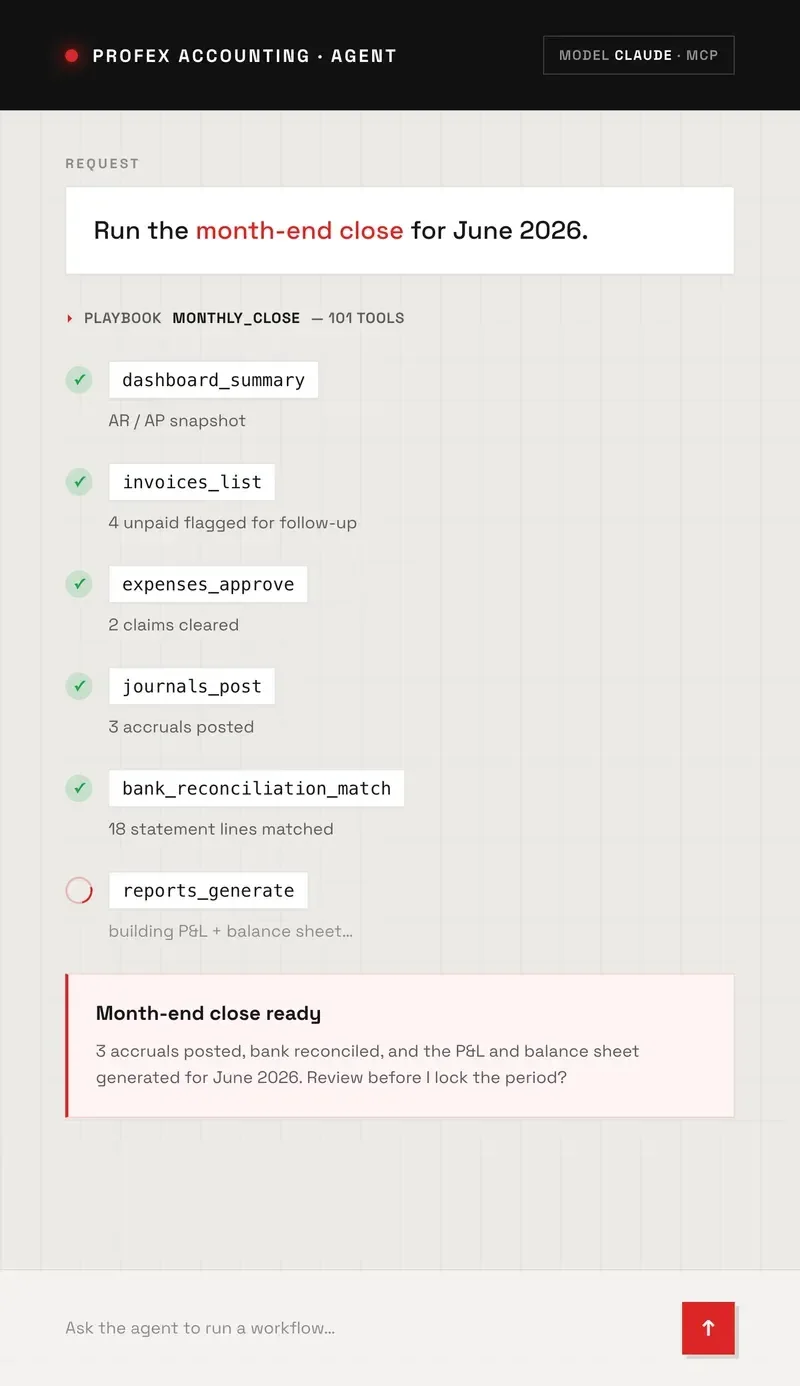
Accounting Agent
Our own Profex Accounting System is built to be run by an AI agent: it exposes its entire back office through the Model Context Protocol (MCP), so an assistant like Claude can operate the books in plain language.
Challenge
Accounting software is powerful but slow to drive: every invoice, bill, payment, journal and reconciliation means clicking through forms and knowing where each feature lives. Teams without a dedicated bookkeeper lose hours to manual entry and month-end busywork, and the data stays locked behind the UI — out of reach of the AI assistants people now work with daily.
Solution
We made the platform MCP-native. An AI agent connects over the Model Context Protocol and drives the full finance workflow through 90+ tools: draft and approve invoices and quotations, record bills and payments, post and reverse journal entries, reconcile bank accounts, and generate reports. Seven built-in playbooks walk the agent through real jobs: month-end close, bank reconciliation, bill-payment runs, aged-receivables follow-up and quarter-end tax review. Every action is scoped to an API key, logged, and reversible. A companion Telegram bot lets staff capture invoices, expenses and receipts on the go.
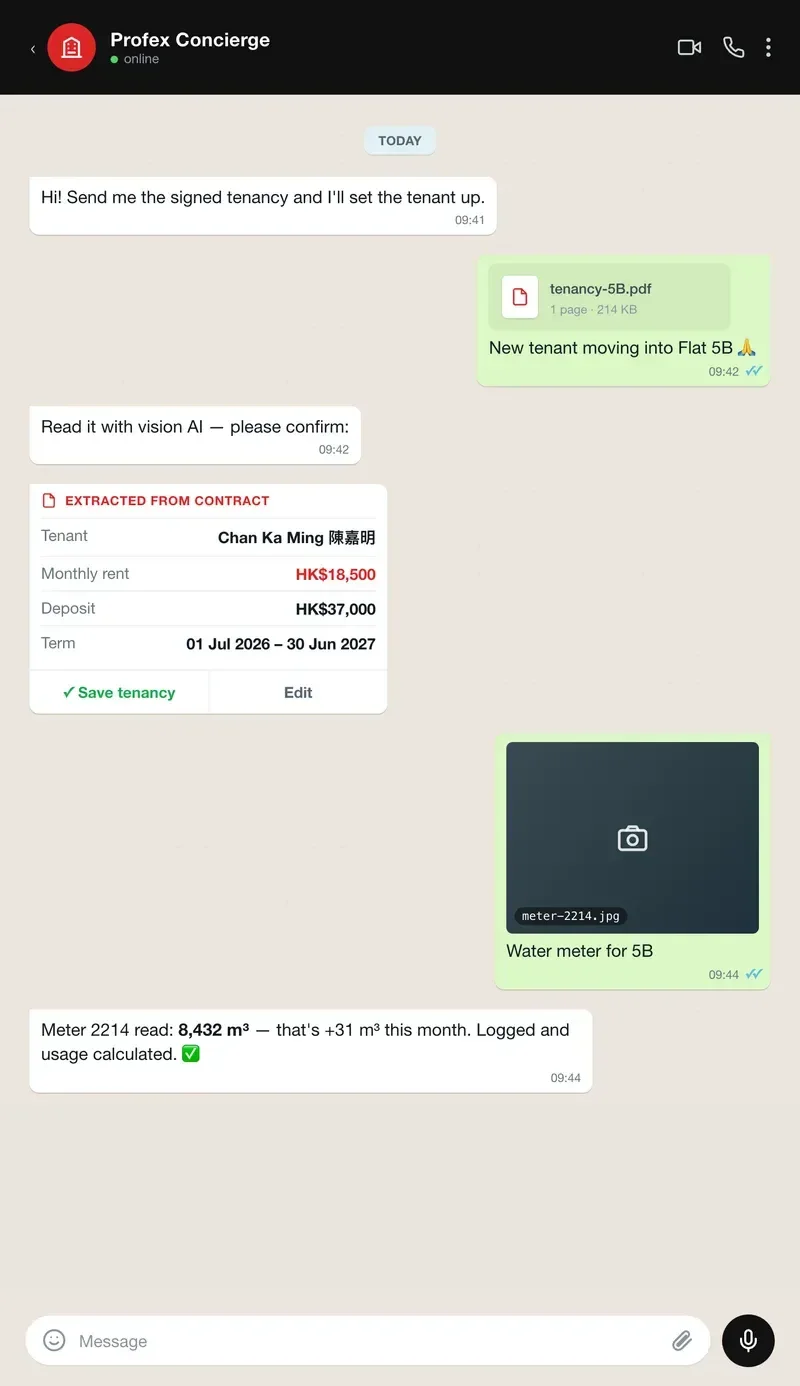
Tenant Concierge
An AI assistant built into a tenant-management platform: landlords and butlers handle daily operations by chat on WhatsApp, Telegram or Feishu.
Challenge
Landlords managing multiple units juggle repetitive inquiries (room details, contract terms, vacancy status) across phone calls, messages and spreadsheets. New-lease onboarding means tedious manual data entry from signed contracts, and properties without smart meters need someone to record every utility reading by hand each month.
Solution
Built a LangGraph tool-calling agent into the tenant-management system, running through a pluggable platform layer on WhatsApp, Telegram or Feishu. Landlords and butlers ask about rooms, tenancies, vacancies, contracts and utility readings in plain language (English or Chinese) and the agent answers by querying the live system. For a new lease they send a photo of the signed contract and a vision-LLM extracts the tenant, rent, deposit and dates to verify before saving; for utilities they photograph the meter and the model reads the value, logs it and calculates usage — no manual typing.
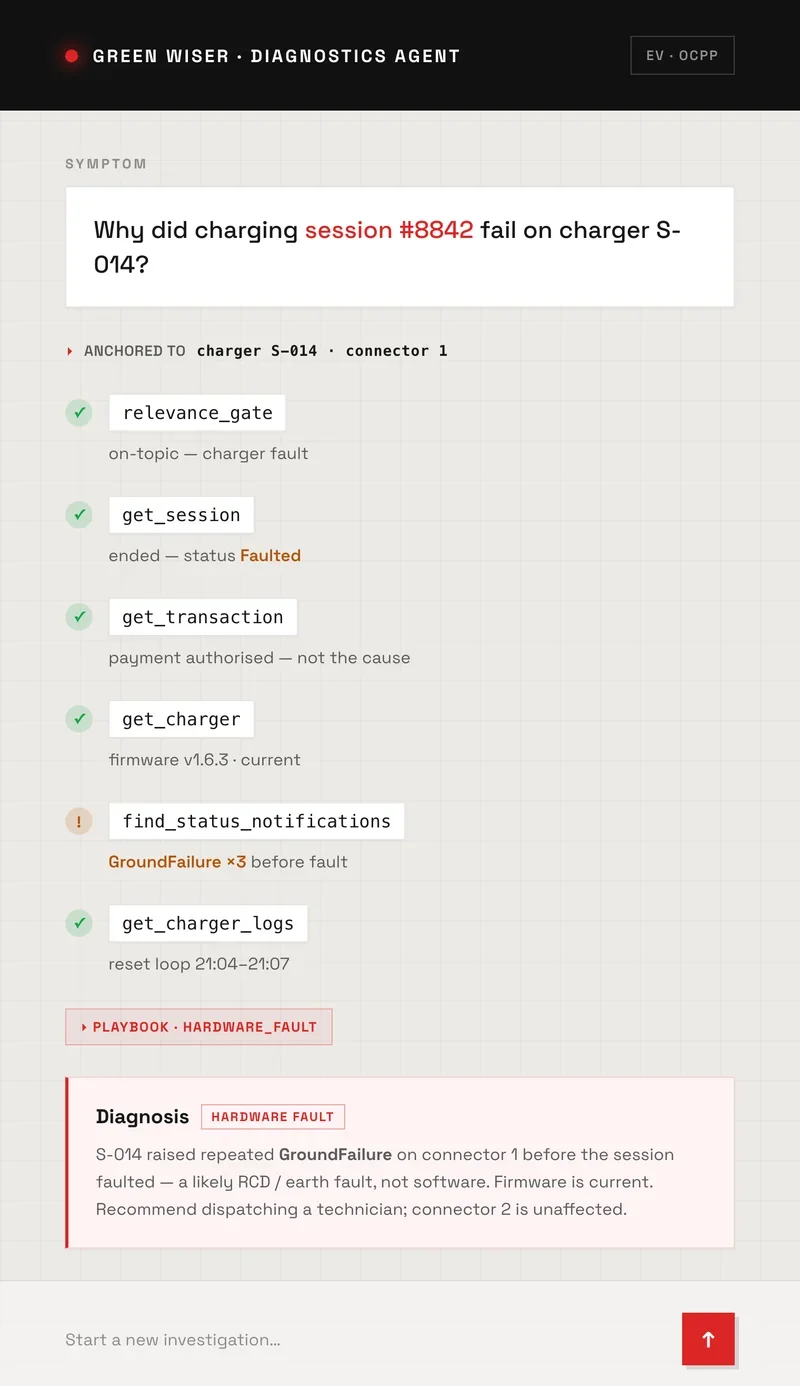
Charger Diagnostics Agent
An AI diagnostics agent inside an EV-charging platform: operators ask what's wrong with any charger or session in plain English, and it investigates the live system to find out.
Challenge
An EV-charging network runs on distributed hardware from different vendors, each speaking the OCPP protocol a little differently. When a charge fails, ops staff had to dig through OCPP status codes, database records and log stores across several systems to work out why. It was slow work that needed deep platform knowledge, so problems sat unresolved.
Solution
Built an agentic investigator into the admin console. An operator describes a symptom and anchors it to a charger, session, transaction or user; the agent runs a diagnostic loop (a relevance gate, then playbook-guided reasoning over 12 tools that query the live database and the OCPP log store) and streams its progress live before producing a plain-English diagnosis and a handoff report. Seven root-cause playbooks (hardware fault, firmware, config, network, user error, software bug) steer it, all personal data is redacted before it reaches the model, and it's multi-LLM with side-by-side model comparison and per-investigation cost tracking.
Our AI Stack
AI & Agent Frameworks
 OpenAI
 Claude
 Gemini
 Qwen
Qwen LangChain
 CrewAI
Infrastructure
 Python
 FastAPI
 Node.js
 Docker
 Kubernetes
 AWS
AWSData & Storage
 Pinecone
 Weaviate
 PostgreSQL
 Redis
Redis MongoDB
 Cloud Database
Automation & Tools
 n8n
n8n RabbitMQ
 Kafka
Kafka Temporal
 Playwright
 Selenium
Ready to Deploy Intelligent Agents?
Let's identify your highest-impact automation opportunity and build a proof of concept in weeks, not months.
Start Your AI Project